
Jesus: The Last Adam
PS. NATHAN CANTO | AUGUST 23, 2026
There comes a defining moment in every Christian’s journey, when Scripture stops being merely a collection of stories and historical doctrines and becomes a living reality. In 1 Corinthians 15, the Apostle Paul brings his theological argument to its climax with one foundational truth: Jesus Christ is risen from the dead.
Our worldview, our hope, and the way we live on this earth are all rooted in the reality of the resurrection. If Christ has not been raised, Paul says, then our faith is futile and our preaching is empty. But Christ has been raised.
Paul reminds us in 1 Corinthians 15:3–6:
“Christ died for our sins according to the Scriptures, that he was buried, that he was raised on the third day according to the Scriptures, and that he appeared to Cephas, and then to the Twelve. After that, he appeared to more than five hundred of the brothers and sisters at the same time.”
Because of the eyewitness testimony and the historical reality of the empty tomb, we can trust the claims of Jesus. He is fully God and fully man. The One who could bear our sin, defeat death, and restore humanity to God’s original design.
To help us understand the magnitude of that restoration, Paul draws a parallel between two central figures in human history: the first Adam and the Last Adam.
The Original Blueprint and the warped Mirror
To understand why the Apostle Paul calls Jesus the last Adam, we must return to the Garden of Eden. When God created humanity, He established three foundational realities: image-bearing, dominion, and proximity.
Genesis 1:26–27 says:
“Then God said, ‘Let us make mankind in our image, in our likeness, so that they may rule over the fish in the sea and the birds in the sky, over the livestock and all the wild animals, and over all the creatures that move along the ground.’ So God created mankind in his own image, in the image of God he created them; male and female he created them.”
Humanity was created to be a living reflection of God, a mirror turned toward Him in worship, reflecting His character, goodness, love, and glory into creation.
God also entrusted humanity with dominion: not domination for selfish gain, but loving stewardship that reflected His righteous order throughout the earth.
And then there was proximity. Eden was the place where humanity enjoyed unbroken fellowship with its Creator. Adam and Eve lived in intimate relationship and proximity with God, experiencing His presence without separation or shame.
Then came Genesis 3.
Through a single act of disobedience, the first Adam shattered the blueprint.
Sin did more than cause humanity to break a rule. It distorted human nature. The mirror that was created to reflect God’s glory turned inward, reflecting self-interest, pride, and worldly desire.
Dominion became distorted into control and exploitation, creating conflict between humanity and creation.
And proximity was broken. Humanity was separated from the very presence and source of life for which it had been created.
Thankfully, the story did not end in the garden.
Jesus: The Most Human Human
In 1 Corinthians 15, Paul contrasts the failure of the first Adam with the victory of Jesus Christ.
“For since death came through a man, the resurrection of the dead comes also through a man. For as in Adam all die, so in Christ all will be made alive.”
1 Corinthians 15:21–22
Jesus came fully God and fully man, but unlike Adam, He lived as humanity was always intended to live: completely surrendered to the Father, perfectly aligned with God’s purposes, and completely free from sin.
Jesus was, in that sense, the most fully-human human to ever walk the earth.
He revealed what humanity was designed to be.
Paul writes:
“The first man Adam became a living being; the last Adam, a life-giving spirit.”
1 Corinthians 15:45
The first Adam brought death into humanity’s story. The Last Adam brought life.
Where in Adam, the image of God was distorted, Jesus perfectly revealed it.
Where Adam surrendered dominion, Jesus demonstrated righteous authority under the Kingdom of God.
Where Adam experienced separation from God, Jesus opened the way for humanity to be reconciled to God.
And through His resurrection, Jesus did more than restore our access to God. He sent the Holy Spirit to dwell within us.
The contrast is striking:
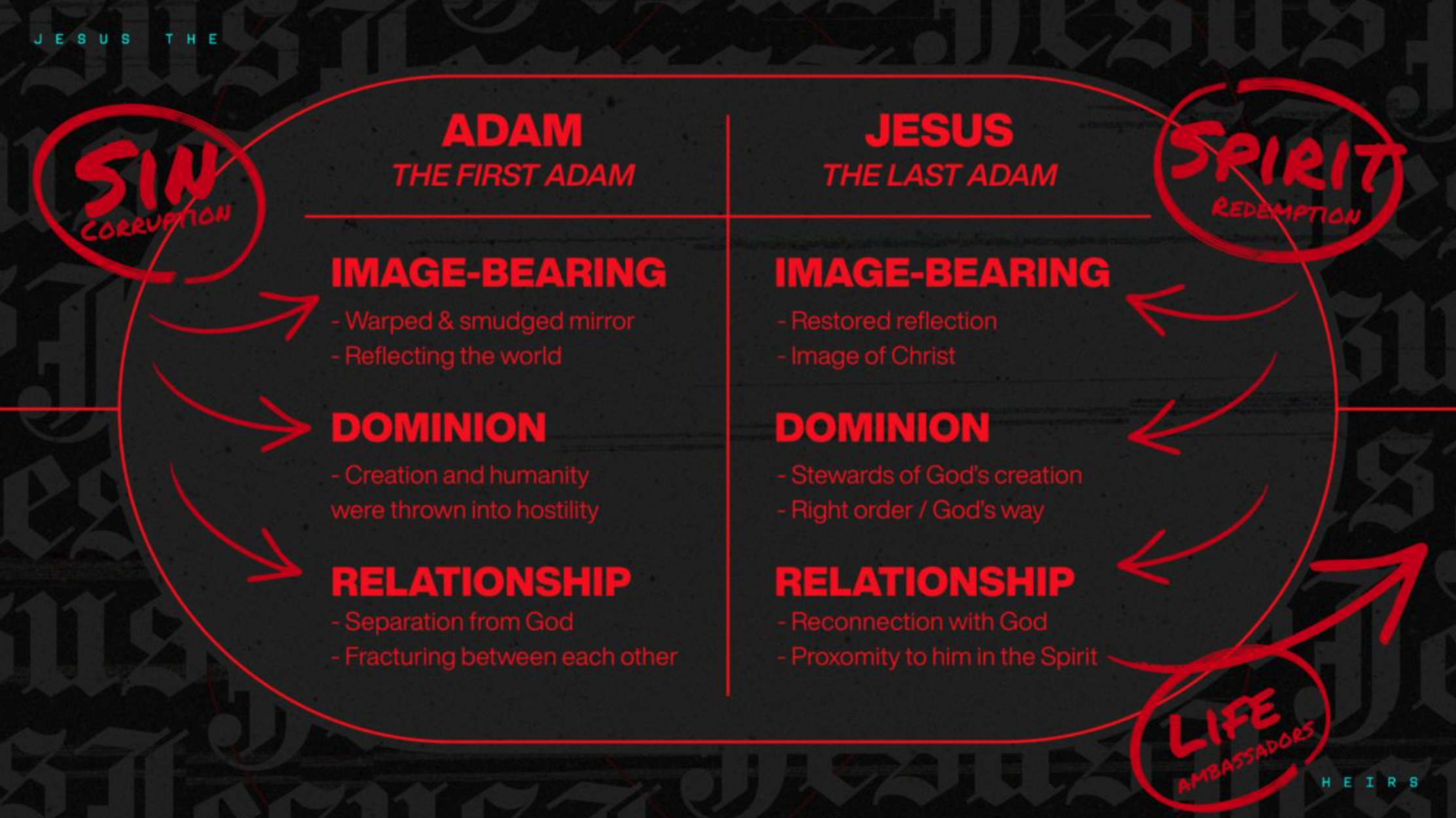
The Last Adam does not merely repair what Adam broke. In Christ, God begins something greater: a new creation, a restored humanity, and a people empowered by His Spirit to carry His Kingdom into the world.
Reframing Eternal Life: Zoe Aionios
We often think of eternal life primarily as living forever, and going to heaven after we die. But the biblical idea is much richer.
The phrase Zoe Aionios points to the life of the age to come. In the Jewish understanding of history, there was the present age and the age to come. The present age is characterized by sin, death, decay, and brokenness. The age to come is characterized by the fullness of God’s reign, justice, peace, and restoration.
The remarkable message of the gospel is that, through Jesus, the life of the age to come has entered the present.
Paul writes in 2 Corinthians 5:17:
“Therefore, if anyone is in Christ, the new creation has come: The old has gone, the new is here!”
Eternal life does not begin when your heart stops beating.
It begins when you come alive to Christ.
The moment you surrender to Jesus, the Holy Spirit takes up residence within you. You become a participant in the life of the coming age while still living in the present one.
This is the tension at the heart of Christian faith: the “already” and “the not yet”.
The Kingdom has already arrived in Christ. Forgiveness, healing, reconciliation, transformation, and new creation are available to us now.
And yet, creation still awaits the final completion of God’s work. Death remains an enemy, but not a permanent one.
Paul declares:
“The last enemy to be destroyed is death.”
1 Corinthians 15:26
We are not called to sit passively and wait for the future. We are called to live today from the reality of the resurrection.
Kingdom Outposts and Ambassadors
So what do we do with this reality?
Paul gives us the answer in 2 Corinthians 5:18–20:
“All this is from God, who reconciled us to himself through Christ and gave us the ministry of reconciliation: that God was reconciling the world to himself in Christ, not counting people’s sins against them. And he has committed to us the message of reconciliation. We are therefore Christ’s ambassadors, as though God were making his appeal through us.”
An ambassador lives in a foreign land while representing the values, priorities, vision, and mission of the kingdom that sent them.
That is who we are.
We are Christ’s ambassadors.
We are not simply waiting for a future day when heaven and earth will fully overlap. Through the Holy Spirit, God has already made His dwelling place within His people.
You are a Kingdom outpost.
The presence of God is not confined to a building, cathedral, or sanctuary. As a believer, you carry His presence into the world. You carry that calling into your marriage. Into your parenting. Into your workplace. Into the marketplace. Into politics and civic life. Into your friendships. Into your neighborhood. Into your community.
Everywhere you go, you have an opportunity to represent the King and make His appeal to the world.
We are not merely waiting for the Kingdom. We are called to embody it.
What Is Your Mirror Pointed At?
Today, we recognize the grace and forgiveness we have received through Jesus Christ. Jesus, the Last Adam, died for our sins and rose from the dead, making new life possible for all who belong to Him. Through Him, we have been restored, filled with His Spirit, and called to live under His lordship. The question before us is simple: What are you reflecting? A mirror reflects whatever it is pointed toward, so if Christ has restored our image-bearing capacity, what is your life fixed upon? Are you continually looking toward Jesus, or has your attention become consumed by the patterns, anxieties, ambitions, and desires of the world?
The first Adam sinned and hid in shame, but the Last Adam brings freedom. Jesus does not call us to remain trapped in shame, hiding from God and from one another. He cleanses us, restores us, fills us with His Spirit, and sends us into the world as His representatives. The resurrection is not only a promise for the future; resurrection life has already begun, and the Spirit of the risen Christ lives within us. So let us live from that reality, walk in freedom, reflect His character, carry His presence, and represent His Kingdom wherever we go. Let our lives become a clear reflection of Jesus, His love, His character, His truth, and His life within us.
As Paul reminds us:
“Therefore, my dear brothers and sisters, stand firm. Let nothing move you. Always give yourselves fully to the work of the Lord, because you know that your labor in the Lord is not in vain.”
1 Corinthians 15:58
